Optical System
- Optical Design: F/8 Ritchey–Chrétien system
- Aperture: 2 m
- Primary Focal Ratio: F/2.2
- Image Quality: 80% encircled energy within 0.4 arcsec on-axis
- Wavelength Range: 0.35–2.5 μm
- Field of View:
- Cassegrain focus: 1 degree
- Nasmyth focus: 12 arcmin
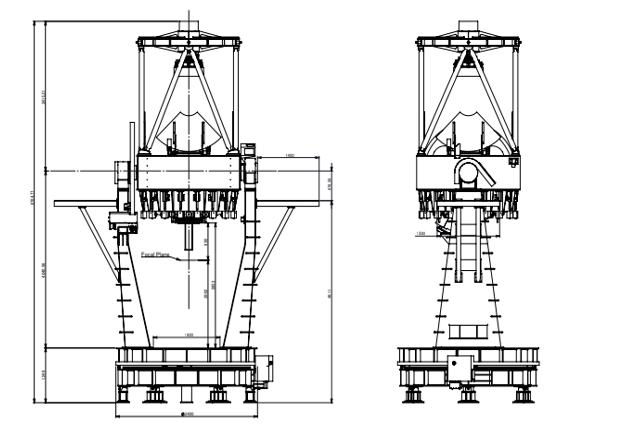
Available Foci
The telescope provides three observing foci, including one Cassegrain focus and two Nasmyth foci.
- The Cassegrain focus supports instruments up to 500 kg, with maximum dimensions of 2 m × 2 m × 2 m.
- Each Nasmyth focus is equipped with a 1.5 m × 1.5 m instrument platform, supporting payloads up to 500 kg.
- Focus switching is achieved via a motorized tertiary mirror controlled by the telescope control system, with switching time less than 60 seconds.
Mount
- Mount Type: Friction-driven Alt-Azimuth mount
- Maximum Slew Speed: 4°/s
- Pointing Accuracy: 2 arcsec (RMS) after software correction at elevations above 30°
- Tracking Accuracy: Tracking error < 0.3 arcsec over 10 minutes at elevations above 30°
- Total Installation Height: 8,664 mm
Control Interface
The 2-Meter Telescope control cabinet manages telescope pointing, slewing, and tracking operations, and also performs focus switching and automatic synchronization of the Nasmyth field rotator.
Since the observatory dome follows Nishimura’s integrated design, the system also enables synchronized dome control during observations. The control cabinet communicates with the main server via TCP/IP connections for command transmission and system coordination.
- Control Software:
- Native control software provided by Nishimura operates under a Windows environment and supports full command execution and system monitoring. However, external connectivity is not supported.
- Therefore, a dedicated telescope control system is currently being developed using UNAM’s web-based observing platform. The new system will integrate:
- automated scheduling
- environmental monitoring
- data storage and distribution
- data preprocessing
- alert systems
- interruption recovery and automatic restart mechanisms
- These developments aim to enable future remote and fully autonomous observing operations.